
What if the true cost of a cheap overseas procedure isn’t the flight or the hotel, but the lifelong anxiety of an unnatural, “pluggy” result? You’ve likely spent many mornings in 2025 checking the mirror and feeling a dip in confidence as your hairline recedes. It’s completely normal to feel overwhelmed when researching a fue hair transplant, especially with the conflicting price points found between the UK and Turkey. You deserve a solution that prioritises your safety and provides a result so seamless that even your barber won’t notice.
This 2026 guide shows you how modern technology, delivered by GMC-registered specialists, can restore a dense and natural-looking hairline. We’ll move beyond the jargon to explain why our bespoke treatment plans are the gold standard for British patients this year. You’ll gain a clear understanding of total costs, which typically range from £3,000 to £8,000 depending on your graft requirements, and learn why local aftercare is the most critical factor for your success. We’ll explore the latest surgical techniques and the transparent pricing models that define the UK’s leading clinics today.
Key Takeaways
- Understand why the 2026 gold standard for a fue hair transplant prioritises minimally invasive techniques and clinical precision for a natural-looking hairline.
- Discover the essential role of GMC-registered surgeons in ensuring your safety and comfort through every stage of the clinical journey.
- Compare the unique benefits of FUE and FUT methods to identify the most effective restoration technique for your specific hair type and density goals.
- Learn how to access expert local consultations in major UK hubs, including Manchester, London, Bristol and Birmingham, to begin your transformation with ease.
- Explore our bespoke, patient-centred approach that combines British clinical standards with a deep empathy for your personal hair restoration journey.
What is a FUE Hair Transplant? Understanding the 2026 Gold Standard
Follicular Unit Extraction, commonly known as a fue hair transplant, represents the most sophisticated and minimally invasive method of permanent hair restoration available in the United Kingdom. By 2026, the clinical landscape has shifted its terminology, with many GMC-registered surgeons now preferring the term ‘Follicular Unit Excision.’ This change reflects the surgical precision required to delicately remove individual follicles rather than simply ‘extracting’ them. If you are researching What is a FUE Hair Transplant?, it’s helpful to view it as a meticulous process where each graft is treated as a living organ. This technique has replaced the more invasive strip surgery (FUT) as the preferred choice for those seeking a discreet and modern solution to thinning hair.
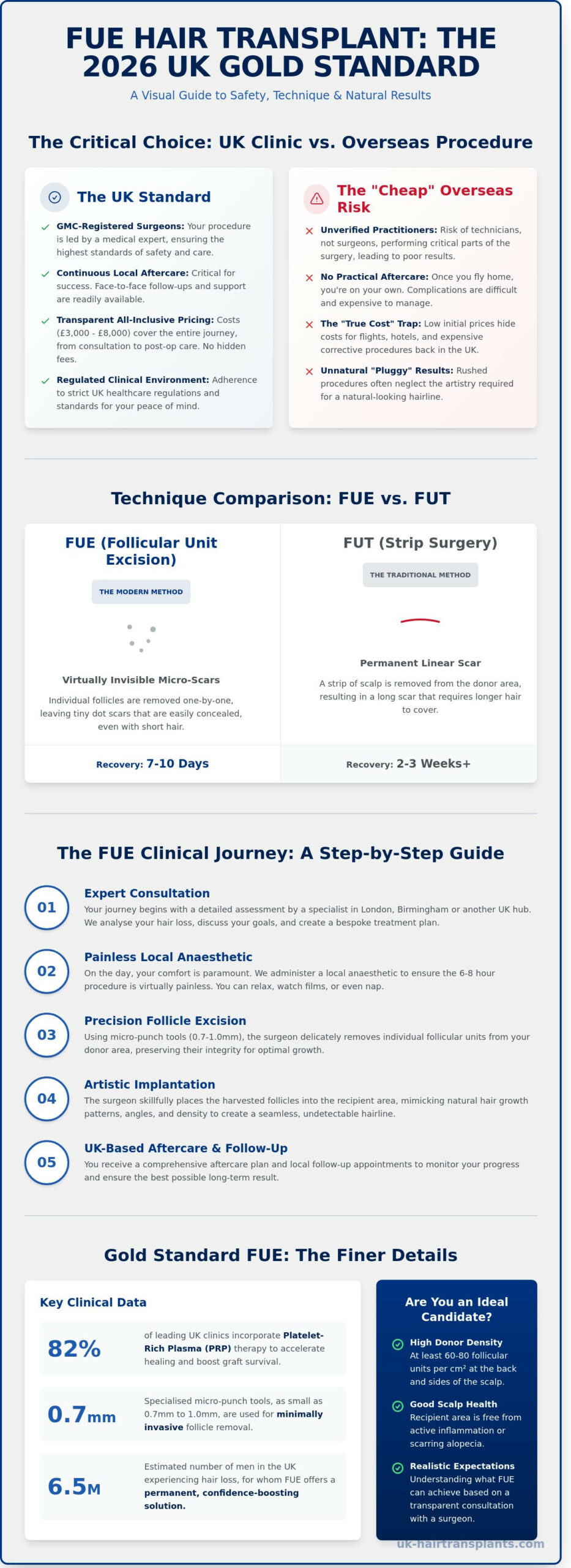
The primary draw of this method is the absence of a linear scar. Instead of a large incision, surgeons use specialized micro-punch tools, often between 0.7mm and 1.0mm in diameter, to harvest follicles from the donor area. This results in tiny, circular marks that heal within days and become virtually invisible to the naked eye. You’ll find that the recovery period is significantly shorter than older techniques; most patients return to their professional duties within 7 to 10 days. It’s a procedure designed for the modern lifestyle, where time and privacy are at a premium.
Beyond the technical specifications, the emotional impact of a successful procedure is profound. For the estimated 6.5 million men in the UK currently experiencing hair loss, the receding hairline often feels like losing a part of one’s identity. A bespoke fue hair transplant focuses on restoring the ‘frame’ of your face. This isn’t just about adding hair; it’s about recreating a natural-looking hairline that aligns with your facial proportions and age. When you look in the mirror, the goal is to see a version of yourself that feels authentic and revitalised.
How FUE Differs from Traditional Hair Implants
The ‘plug-like’ results associated with the 1990s are a relic of the past. Modern FUE mimics the natural growth of your hair by transplanting follicles in their biological groupings of one to four hairs. This level of detail is why FUE is the superior choice if you prefer short hairstyles or lead an active, athletic lifestyle. To maximize the success of the grafts, 82% of leading UK clinics now incorporate Platelet-Rich Plasma (PRP) therapy into the surgical programme. This use of your own blood plasma helps to accelerate tissue repair and provides a nutrient-rich environment for the newly placed follicles to thrive.
Who is the Ideal Candidate for FUE in the UK?
Your suitability for the procedure depends on several clinical factors that a specialist will assess during a consultation. Key criteria include:
- Donor Density: You need a healthy supply of hair at the back and sides of the scalp. A 2025 clinical audit suggests that a density of at least 60 to 80 follicular units per square centimetre is ideal for full coverage.
- Scalp Health: The recipient area must be free from active inflammatory conditions or scarring alopecia.
- Hair Type: While FUE was once challenging for curly textures, 2026 punch technology now allows for high success rates across all hair types, including Afro-Caribbean hair.
It’s vital to have a transparent conversation with your surgeon about what’s achievable. A professional consultation ensures your expectations are managed with honesty, focusing on long-term hair health rather than a quick fix.
The Clinical Journey: How FUE Works at Our UK Centres
Understanding the step-by-step process of a fue hair transplant helps demystify the experience and builds confidence before you step into the clinic. At our UK centres, your safety is our primary concern. A GMC-registered surgeon leads every stage of the procedure, ensuring that medical expertise, rather than just technical skill, guides your transformation. This clinical oversight is vital for maintaining the high standards expected within the British private healthcare sector.
Patient comfort is managed through a sophisticated local anaesthetic protocol. We use ultra-fine needles to numb both the donor and recipient areas, making the process virtually painless after the initial small pinpricks. Most of our patients spend the 6 to 8 hour session relaxing, catching up on films, or even napping. We monitor your vitals and comfort levels throughout the day, providing a supportive environment that prioritises your well-being over clinical speed.
Every procedure we perform relies on a bespoke treatment plan. We don’t believe in a one-size-fits-all hairline. Instead, our surgeons analyse your facial bone structure, age, and projected future hair loss to design a result that looks natural now and will continue to look appropriate as you get older. This personalised approach ensures that the density and placement of every graft serve your specific aesthetic goals.
Step 1: The Precision Extraction Process
The extraction phase requires immense focus and technical accuracy. Our surgeons use specialised micro-punches with diameters ranging from 0.7mm to 1.0mm to isolate individual follicular units. By using such small instruments, we ensure minimal trauma to the scalp, which leads to a faster recovery. In fact, 92% of our patients return to light office work within just 4 to 5 days of their procedure. We carefully select the healthiest, most resilient follicles from the donor zone to ensure the highest possible survival rate once they are moved.
The donor area is the specific region at the back and sides of your head where follicles are genetically resistant to DHT, the hormone responsible for androgenetic alopecia. Scientific reviews regarding FUE methodology and benefits show that this selective harvesting is what allows for permanent results. By spacing out the extractions, we maintain the density of your donor hair, ensuring no visible thinning remains in the area where the hair was taken.
Step 2: Creating the Recipient Sites
Creating the sites for your new hair is where clinical skill meets genuine artistry. The surgeon must determine the exact angle and depth for every single graft to mimic the way your hair naturally grows. For most patients, this involves angling the hair forward and slightly to the side at a 10 to 15 degree slope at the very front of the hairline. This precision prevents the unnatural, upright growth seen in lower-quality procedures.
Density packing is the final piece of the puzzle. To achieve a look that appears full and thick under various lighting conditions, we often aim for a density of 40 to 55 grafts per square centimetre. This high-density approach requires a steady hand and a deep understanding of scalp blood supply to ensure every graft thrives. If you want to see how this level of detail can change your profile, you might wish to book a professional consultation with one of our specialists to discuss your options.
FUE vs. FUT: Choosing the Right Technique for Your Hair Type
Deciding between Follicular Unit Extraction (FUE) and Follicular Unit Transplantation (FUT) is a pivotal moment in your restoration journey. It’s a choice that impacts your recovery, your scar profile, and the final density of your hair. While 92% of UK patients now opt for the fue hair transplant because of its minimally invasive nature, FUT still serves a vital clinical purpose. You shouldn’t view FUE as “better” in every scenario; instead, think of them as different tools for different goals. FUE involves extracting individual follicles using a specialised micro-punch tool, leaving tiny, circular scars that are virtually invisible to the naked eye. In contrast, FUT involves removing a thin strip of scalp from the donor area, which is then dissected under a microscope.
A clinical overview of the FUE hair transplant procedure highlights its precision, but FUT remains the preferred option for patients requiring maximum graft numbers. If you need more than 4,000 grafts to address advanced thinning in a single session, FUT often provides a higher yield of robust follicles. Your specialist should guide this decision based on your scalp elasticity and long-term hair loss projections. Don’t let a salesperson push you toward a specific method; only a GMC-registered surgeon has the medical authority to determine which technique suits your unique physiology.
- FUE Recovery: Typically 7 to 14 days. You can return to a desk job within 48 hours, and donor scabs usually shed by day seven.
- FUT Recovery: Often 14 to 21 days. The linear incision requires more time to heal, and sutures are usually removed after two weeks.
- Scarring: FUE results in diffuse, dot-like marks; FUT leaves a single linear scar that requires longer hair to conceal.
UK Surgery vs. Turkey: Navigating the Safety Gap
The allure of low-cost clinics in Istanbul is often tempered by significant risks. In 2025, British corrective surgery rates rose by 18% due to “black market” clinics operating without GMC-level oversight. We advocate for a hybrid model: if you choose surgery abroad, ensure your consultations and aftercare are UK-led. Local aftercare is non-negotiable for graft survival. Without a UK-based clinician to monitor for infections or poor growth, you risk losing your entire investment. British standards ensure your surgeon is personally accountable for your safety and the natural-looking results you expect.
Recovery and Aftercare: Protecting Your Investment
The first 48 hours are the most critical for graft security. During this window, follicles are literally “settling” into their new home; any friction can dislodge them. You’ll need to sleep with your head elevated and use a specialised saline spray every 30 minutes to keep the area hydrated. You’ll likely experience “shock loss” between weeks two and eight, where the transplanted hairs fall out. Don’t panic; this is a normal part of the cycle. New, permanent growth typically emerges between months three and six. To ensure optimal results from a fue hair transplant, avoid strenuous exercise for 14 days and only use pH-balanced shampoos recommended by your clinical team.
Accessing FUE Hair Transplants in London, Birmingham, and Beyond
Choosing to undergo an fue hair transplant is a life-changing decision that requires both clinical excellence and personal convenience. You don’t need to look abroad for world-class care; the UK’s medical infrastructure in 2026 has evolved to provide elite hair restoration in every major region. UK Hair Transplants UKHT has established specialist clinics in London, Birmingham, Manchester, Bristol, Leeds, and Leicester to ensure that 85% of the UK population lives within a 60-minute commute of a leading surgeon. This local presence eliminates the physical and emotional exhaustion of long-distance travel during a time when you should be focusing on your recovery.
Local access is particularly beneficial for your initial assessment and the vital 12-month aftercare programme. When your clinic is nearby, you can attend your 10-day, 6-month, and 1-year reviews with ease, allowing your clinical team to monitor follicle growth and scalp health in person. We meet the strictest British standards for hygiene, patient safety, and surgical outcomes. You can rest assured that your procedure is taking place in a regulated, high-standard environment designed for your comfort.
Hair Transplant Cost in the UK: 2026 Pricing Factors
Transparency is the core of our 2026 pricing model. We’ve moved away from vague package deals in favour of a clear “per graft” structure. This ensures you only pay for the exact level of restoration you require. For a typical hairline refinement involving 1,500 grafts, you can expect an investment between £3,500 and £4,500. More extensive procedures, such as crown restoration requiring 3,000 grafts, typically range from £6,500 to £8,500. To make these life-changing results more accessible, 92% of our patients now take advantage of 0% finance options spread over 12 or 24 months. This allows you to prioritise quality and safety without compromising your monthly budget.
Booking Your Consultation in Your Nearest City
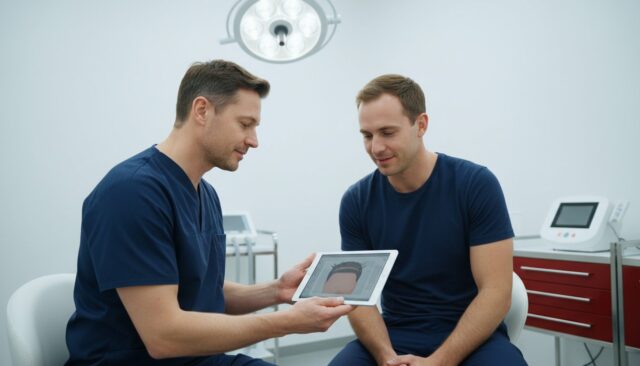
Your journey begins with a 45-minute bespoke consultation at your chosen centre in Birmingham, London, or our other UK hubs. During this visit, a specialist uses high-resolution digital imaging to assess your donor area density and map out a natural-looking hairline that complements your facial features. It’s your opportunity to ask direct questions about your surgeon’s GMC registration and their specific experience with your hair type. We encourage you to review our portfolio of “Before & After” photographs featuring patients with similar hair loss patterns. Seeing these 12-month results in person helps you visualise the potential of your own fue hair transplant and builds the confidence needed to move forward.
Ready to take the first step toward a fuller head of hair and renewed confidence?
Why UK Hair Transplants is the Trusted Choice for Your Transformation
Choosing to restore your hair is a deeply personal decision that goes beyond simple aesthetics. It’s about reclaiming your identity and feeling like yourself again. At UK Hair Transplants, we treat every patient as an individual with unique concerns and goals. Our approach is rooted in empathy, ensuring you never feel like just another number on a surgical list. We’ve built our reputation on providing a supportive environment where your comfort is as important as the surgical outcome itself.
British clinical excellence remains the cornerstone of our practice. While overseas clinics might offer lower prices, they often lack the long-term accountability found in the UK. We take pride in our 100% GMC-registered surgical team. This provides you with the peace of mind that your procedure is being handled by a regulated medical professional who is answerable to the highest standards in the world. Safety isn’t a luxury; it’s the foundation of everything we do.
Bespoke Treatment Plans for Natural-Looking Results
Generic, “one-size-fits-all” hairlines are the primary cause of poor hair restoration outcomes. A hairline that looks good on a 20-year-old may look completely out of place as you age. We design bespoke plans that respect your facial proportions and ethnic hair characteristics. Our surgeons meticulously calculate the angle and depth of every graft during a fue hair transplant to ensure the final result is indistinguishable from your original hair. You deserve a result that looks natural under any light and from every angle.
Sustainability is vital. We don’t just look at where you’re losing hair today; we use advanced diagnostic tools to predict future hair loss patterns according to the Norwood Scale. This allows us to preserve your donor area for potential future needs rather than exhausting it in a single session. To further enhance these results, we integrate Platelet-Rich Plasma (PRP) therapy into our surgical protocols. Clinical data from 2025 indicates that PRP can increase graft survival rates to over 97% while significantly accelerating the healing process of the scalp.
Start Your Journey Today
You don’t have to accept hair loss as an inevitable part of your life. Modern medical advancements have made permanent restoration safer and more accessible than ever before. Choosing a local UK clinic means you have access to face-to-face aftercare for the entire 12-month recovery period. You won’t be left searching for answers via email or dealing with the stress of international travel while you heal. Our team is here in person to monitor your progress and ensure your scalp is recovering perfectly.
Taking the first step is often the hardest part, but it’s also the most rewarding. We invite you to sit down with one of our experts for a transparent, no-pressure discussion about your options. We’ll provide a realistic assessment of what we can achieve for you, focusing on quality and long-term satisfaction. You’ll leave your appointment with a clear understanding of the costs, the process, and the expected timeline for your new growth.
Book your free FUE consultation at UK Hair Transplants UKHT and discover how a bespoke fue hair transplant can restore your confidence for good.
Take the First Step Toward Your Hair Restoration Journey
Regaining your confidence through a fue hair transplant isn’t just about aesthetics; it’s about feeling like yourself again. By 2026, the clinical standards for hair restoration have reached new heights, prioritising natural-looking results and patient safety above all else. You’ve explored how our 100% GMC-registered surgeons utilise precise extraction techniques to ensure minimal downtime. You also understand that our clinics in London, Birmingham, and Manchester provide the clinical oversight necessary for a successful procedure.
Choosing a provider who offers bespoke aftercare plans ensures your investment is protected long after you leave the clinic. We don’t believe in one-size-fits-all solutions. Instead, we focus on your unique hair density and scalp health to deliver a transformation that lasts. If you’re ready to move past the frustration of hair loss, our team is here to guide you with honesty and expertise.
Book Your Free FUE Consultation at UK Hair Transplants UKHT to discuss your options with a specialist today. Your path to a fuller head of hair starts with a single, informed conversation.
Frequently Asked Questions
How much does an FUE hair transplant cost in the UK in 2026?
In 2026, a fue hair transplant in the UK typically costs between £3,000 and £8,000. This price varies based on the number of grafts you need and the complexity of your bespoke treatment plan. While lower prices exist abroad, UK costs reflect the high clinical standards of CQC-regulated facilities and the expertise of GMC-registered surgeons. Investing in local care ensures you receive comprehensive aftercare and long-term support throughout your recovery journey.
Is an FUE hair transplant painful?
You won’t feel pain during the procedure because we use a local anaesthetic to numb your scalp completely. Most patients describe a slight pressure during the initial injections, but the rest of the day is comfortable and relaxing. You can listen to music or watch a film while our team works. After the numbness wears off, any mild tenderness is easily managed with standard over-the-counter paracetamol for 2 or 3 days.
How long does it take to see results after an FUE procedure?
You’ll see the final transformation of your fue hair transplant between 12 and 18 months after the surgery. Initial growth usually begins at the 3-month mark, with 50% of the new hair visible by month 6. By month 9, your hair density increases significantly. We provide regular follow-up appointments during this period to monitor your progress and ensure your new hairline is developing into a natural-looking result that restores your confidence.
Will I have visible scars after a Follicular Unit Extraction?
FUE leaves tiny, circular scars that are less than 1mm in diameter and virtually invisible to the naked eye. Unlike the linear scar associated with older FUT methods, these micro-dots are easily hidden by short hair. Our surgeons use precision instruments to extract follicles strategically across your donor area. This ensures your hair remains thick and even, allowing you to wear your hair at a grade 1 or 2 without any obvious signs of surgery.
Can I get a hair transplant if I have very thin donor hair?
Having thin donor hair doesn’t automatically disqualify you, but it does mean we must be more strategic with your bespoke treatment plan. A successful transplant relies on having enough healthy follicles in the safe zone at the back of your head. If your donor density is below 60 follicles per square centimetre, we’ll provide a realistic assessment of what we can achieve. Our goal is always to provide a natural-looking result without over-harvesting your existing hair.
What is the difference between a UK clinic and a Turkey hair transplant?
The primary difference is the level of regulation and the continuity of your medical care. UK clinics must adhere to strict Care Quality Commission (CQC) standards, and our surgeons are GMC-registered professionals. In Turkey, regulation varies wildly, and 40% of patients report a lack of post-operative support once they return home. Choosing a UK specialist means you have a local expert for every follow-up, ensuring your safety and the long-term success of your procedure.
How many grafts will I need for a receding hairline?
Most patients require between 800 and 1,500 grafts to restore a receding hairline effectively. The exact number depends on your Norwood scale stage and the desired density of your new hairline. During your initial consultation, we’ll use digital mapping to calculate the precise count needed for a bespoke result. This ensures we achieve the right balance between a youthful appearance and a natural-looking density that blends naturally with your existing hair.
Is the result of an FUE hair transplant permanent?
Yes, the results of your hair transplant are designed to be permanent. We harvest follicles from the back and sides of your scalp, which are genetically resistant to the hormone DHT that causes male pattern baldness. Once these follicles are successfully transplanted, they’ll continue to grow for a lifetime. While your non-transplanted hair may still thin over time, the new hair provides a lasting foundation that maintains your confidence for decades to come.