


What if the secret to a natural hair transplant isn’t about chasing the highest number of follicles, but the clinical precision of where they’re placed? Understanding your specific stage of hair loss on the Norwood Scale is essential to determining how many grafts UK specialists recommend for a bespoke restoration.
You’ve likely seen conflicting online advice, leaving you worried about over-harvesting your donor area or facing an uncertain cost-to-result ratio. It’s exhausting to feel like just another number when what you need is genuine medical guidance.
This 2026 guide replaces confusion with clinical certainty. You’ll gain a realistic estimate of your treatment needs and the confidence to choose a GMC-registered surgeon who prioritises your long-term scalp health over quick fixes.
What Is the Norwood Scale? Measuring Male Pattern Baldness
Losing your hair can feel like losing a part of your identity. To address this with precision, restoration specialists rely on the Norwood Scale — the global gold standard for classifying male pattern baldness. By accurately identifying your stage, surgeons can provide a clear, evidence-based roadmap for your journey.
This tool also helps evaluate whether you’re a suitable candidate for surgery and assesses the health of your donor area. Catching hair loss early gives you more options to preserve existing follicles and prevent advanced thinning. Every scalp is unique, and this scale allows for a bespoke, long-term plan focused on natural results — not temporary fixes.
History and Evolution of the Scale
The system we use today was first developed by Dr. James Hamilton in 1951 and later refined by Dr. O’Tar Norwood in 1975. The Norwood Scale is a seven-stage visual guide, from Stage 1 (minimal loss) to Stage 7 (significant loss, with only a thin band of hair remaining at the sides and back).
Why Self-Diagnosis Can Be Deceptive
It’s easy to misread what you see in the mirror. A common mistake is confusing a “mature hairline” with Stage 2 recession — a mature hairline is a natural part of ageing and doesn’t always signal future baldness. Hair calibre also matters: fine hair may look sparser even with a high follicle count, while thick hair can mask advanced loss.
Relying on photos alone is misleading due to lighting and hair length. That’s why a professional UK consultation is essential. A GMC-registered surgeon uses specialised tools to accurately measure your density and scalp health, ensuring realistic expectations and a donor area capable of supporting the required grafts.
The 7 Stages of Hair Loss: A Visual Breakdown
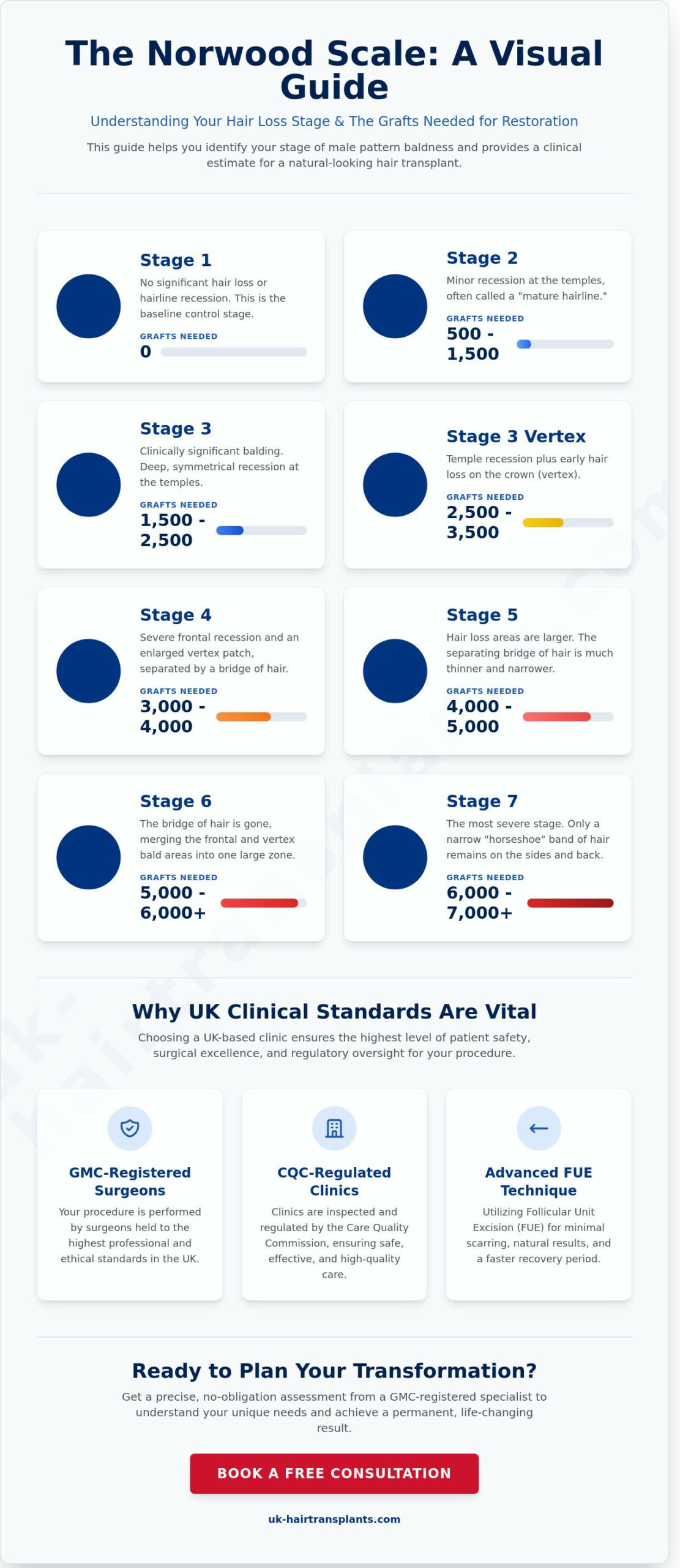
- Stage 1: No significant loss — the control stage.
- Stage 2: Minor temple recession (mature hairline).
- Stage 3 & 3-Vertex: First clinically significant balding. Temple recession becomes prominent; in 3-Vertex, thinning begins at the crown.
- Stages 4–5: Significant frontal recession and crown thinning, with a narrow bridge of hair still separating them.
- Stages 6–7: Severe loss — the bridge disappears, leaving a classic “horseshoe” pattern affecting up to 80% of the scalp’s top surface.
Early Stages (1–3): Prevention & Minor Restoration
Focus is on reinforcing the temples and refining hairline design. Non-surgical options like PRP (Platelet-Rich Plasma) can be highly effective here. For many men, Stage 3 is the tipping point where FUE (Follicular Unit Extraction) becomes the most reliable option. Most patients at this stage need 1,000–2,000 grafts.
Advanced Stages (4–7): Major Reconstruction
Donor hair is finite. At Stage 6, surgeons focus on strategic placement to create density in the most visible areas. By Stage 7, the donor area may be too sparse for full coverage, so priority goes to the frontal hairline for a natural head-on look.
Calculating Grafts Needed by Norwood Stage
One graft typically contains 1–4 follicles. A 2,000-graft procedure could transplant up to 8,000 individual hairs. Surgeons must balance your desired density with long-term donor health — over-harvesting leads to a patchy appearance.
Estimated Grafts by Stage
- Stage 2–3: 1,000–2,000 grafts — ideal for lowering a receding hairline or filling thinning temples.
- Stage 4: 2,000–3,000 grafts — addresses the frontal third and mid-scalp.
- Stage 5–6: 3,500+ grafts — often requires two sessions for proper healing and graft survival.
Factors That Change the Math
- Curly hair provides better coverage than straight hair.
- Thick hair shafts achieve fullness with fewer grafts.
- High contrast (e.g., dark hair on fair skin) requires higher density.
- Age matters: In your 20s or 30s, we preserve donor supply for future procedures.
Why UK Clinical Standards Matter
Identifying your stage and graft needs is only half the battle. The quality of surgical execution and safety standards protect your investment.
The Safety of GMC-Registered Surgeons
GMC registration is non-negotiable — it ensures accountability, technical proficiency, and a surgeon who is legally responsible for your outcome. UK clinics provide sterile, CQC-monitored environments and bespoke planning tailored to your future hair loss patterns, not just your current needs.
Local Aftercare & Long-Term Success
The first 10 days post-surgery are critical for graft survival. Proximity to your clinic means immediate access to your surgical team for any concerns. Reputable UK clinics offer scheduled follow-ups at 3, 6, and 12 months — a level of support impossible when your clinic is thousands of miles away.
Planning Your Restoration with UK Hair Transplants
At our clinics in Birmingham, Bristol, London, and Manchester, GMC-registered surgeons use the Norwood Scale as a blueprint. Our primary technique is FUE (Follicular Unit Extraction), which leaves minimal scarring. We often integrate PRP therapy to stimulate the scalp and improve graft survival.
Our Bespoke Consultation Process
We use digital mapping software for accurate graft counts. Our surgeons design a hairline that ages gracefully with you — what suits a 20-year-old may not suit a 50-year-old. This is long-term planning, not a quick fix.
Start Your Transformation Today
We offer transparent pricing based on your specific graft requirements, with no hidden fees. With clinics across the UK, we provide flexible scheduling and a supportive, clinical environment where your safety and results come first.
Book your free hair consultation at a UK clinic near you
Your Path to a Permanent Solution
Whether you’re at Stage 2 or Stage 6, identifying your Norwood stage is the essential first step. Our GMC-registered surgeons provide the clinical authority to ensure a safe, effective procedure. We operate dedicated facilities in London, Birmingham, Manchester, Leeds, Bristol, and Leicester — bringing world-class restoration to your local area.
You don’t have to settle for thinning hair. A permanent, life-changing transformation is within reach.
Book your free hair loss consultation at our UK clinics today.