


What if the hair you lose during the first 21 days of treatment is actually the most positive sign that your recovery has begun? It sounds counterintuitive, but for many patients visiting our clinics in London, Birmingham, and Manchester, that initial shedding phase is the vital first step toward a thicker, natural-looking result. We know it’s distressing to see more strands in the sink when you’re already worried about thinning. Many people feel trapped between the confusion of 2% versus 5% formulas and the anxiety that minoxidil might just be another temporary fix that’s too messy to manage on your own.
You’re not alone in these concerns, and you deserve a treatment plan backed by clinical authority rather than guesswork. This guide explains how this gold-standard treatment revitalises dormant follicles, helping 80% of users stop further thinning within the first six months of a supervised programme. We’ll outline how our GMC-registered surgeons incorporate these solutions into bespoke restoration strategies that deliver realistic, life-changing outcomes. From managing the “dread shed” to understanding your hair’s transformation at the 12-month mark, we provide the expert roadmap you need for professional hair care right here in the UK.
What is Minoxidil and How Does it Work for Hair Loss?
Understanding the history of hair restoration helps you make informed choices about your scalp health. Minoxidil didn’t start as a solution for thinning hair; it was originally developed in the 1970s as a peripheral vasodilator to treat severe hypertension. During clinical trials, researchers observed an unexpected side effect where patients grew hair on their bodies and scalps. This discovery led to the development of a topical version specifically for androgenetic alopecia, which gained its first regulatory approvals for hair loss in 1988.
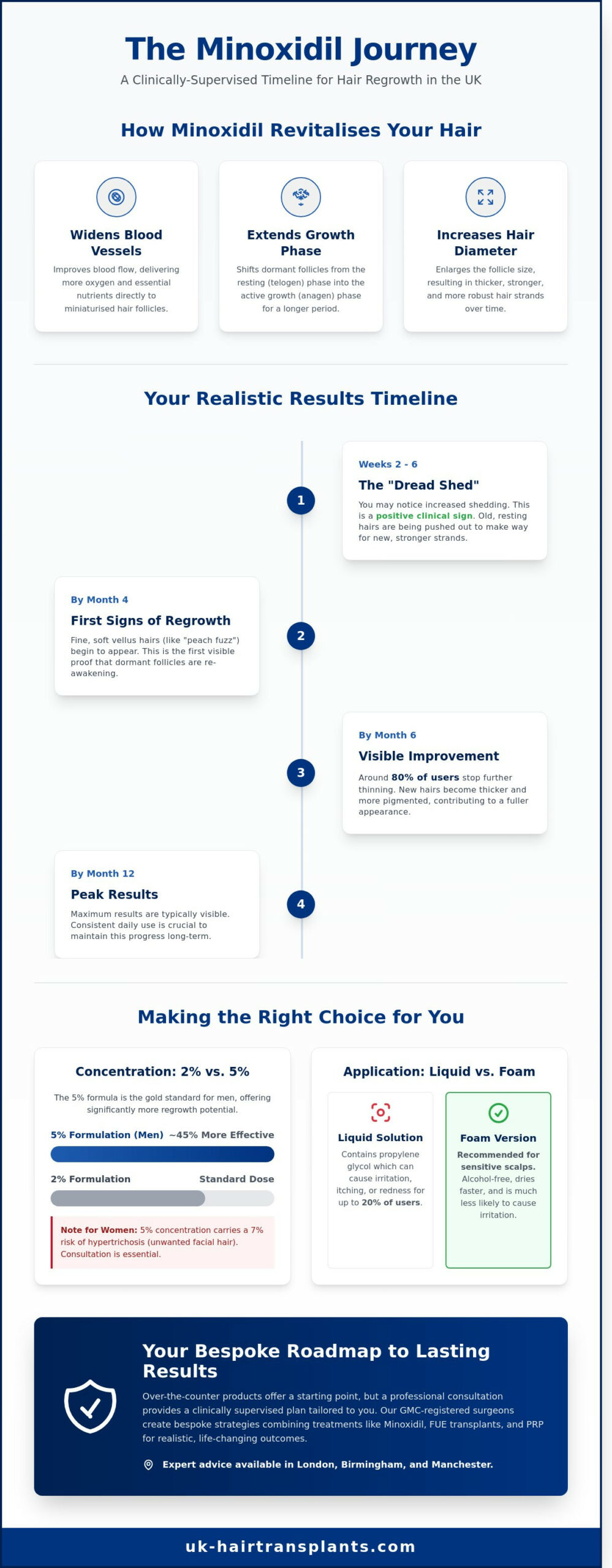
To answer the question What is Minoxidil?, we must look at how it interacts with your biology. It works by shortening the telogen (resting) phase and shifting hair follicles into a prolonged anagen (growth) phase. This process increases the diameter of the hair shaft, providing a fuller appearance over time. In the UK, the MHRA has approved it as a safe, over-the-counter treatment for male and female pattern baldness, offering a non-surgical starting point for many of our patients. While topical foams and liquids are standard, low-dose oral tablets are now emerging as a potent alternative for those who find topical application cumbersome.
The Science of Scalp Blood Flow
Minoxidil functions as a potassium channel opener, which triggers the widening of blood vessels in the scalp. This vasodilation improves the delivery of oxygen and vital nutrients directly to the hair follicles. It’s particularly effective on the vertex, or the crown of the head, where blood flow can be more easily stimulated compared to the frontal hairline. You’ll often see better results in areas where follicles are miniaturised but still active.
- Follicle Enlargement: It increases follicle size for thicker, more robust hair strands.
- Growth Stimulation: It encourages resting follicles to enter the active growth stage sooner.
- Nutrient Delivery: It optimises the scalp environment for long-term hair retention.
UK Concentrations: 2% vs 5% Formulations and UKHT’s 7%
The concentration you choose depends on your specific needs and gender. Clinical data shows that the 5% formulation is roughly 45% more effective at promoting hair regrowth in men than the 2% version. For this reason, 5% has become the gold standard across the UK for male patients. Women are typically advised to start with the 2% solution because the higher concentration carries a 7% risk of causing hypertrichosis, which is unwanted hair growth on the face or forehead.
Choosing between a liquid solution and a foam is often a matter of scalp sensitivity. Liquid versions frequently contain propylene glycol, which helps the minoxidil penetrate the skin but can cause irritation or redness for 20% of users. The foam version is alcohol-free and dries quickly, making it a much more comfortable choice if you have a sensitive scalp. Our experts often recommend the foam to ensure you can maintain your treatment routine without discomfort. This consistency is vital; the benefits of minoxidil only persist as long as you continue the daily application.
At UK Hair Transplants (UKHT), we’ve developed a specialist 7% Minoxidil serum, designed to go beyond standard high-street options—delivering improved results with better tolerability and consistency.
Why 7% Minoxidil Makes a Difference
Most over-the-counter Minoxidil products are available in 2% or 5% strengths. While these can be effective, some patients plateau or see only modest improvements.
The UKHT 7% formulation is designed for patients who want:
- Stronger stimulation of hair follicles
- Improved regrowth in thinning areas
- Better long-term maintenance of existing hair
By increasing the concentration—while maintaining scalp tolerance—we’re able to deliver enhanced results without significantly increasing side effects, thanks to our refined formulation.
Realistic Results: The Minoxidil Timeline for UK Patients
Embarking on a hair restoration journey requires a blend of optimism and clinical realism. When you start using minoxidil, you aren’t just applying a liquid or foam; you’re initiating a biological shift in your hair’s growth cycle. Results don’t happen overnight. Most UK patients begin to see the first tangible changes between month three and month six. During the initial weeks, you might feel a sense of frustration, but understanding the physiological timeline will help you stay the course.
The first landmark is often the most daunting. Between weeks two and six, many users experience a period of increased hair fall. This is known as the “dread shed.” While it feels counterintuitive to lose more hair when you’re trying to save it, this is actually a positive clinical sign. It indicates that the minoxidil is successfully pushing old, resting hairs out of the follicle to make room for new, stronger strands. These shed hairs were already in the telogen phase and destined to fall; the treatment simply accelerates the process to clear the way for the anagen, or growth, phase.
By month four, you should notice fine, peach-fuzz hairs, known as vellus hairs, appearing along the hairline or crown. These aren’t the final result, but they’re a signal that your follicles are responding. Between month six and month twelve, these hairs typically mature into terminal hairs, which are thicker and more pigmented. This is when you’ll achieve peak density. If you’re unsure whether a topical approach or a more permanent solution is right for you, our bespoke treatment plans can provide the clarity you need.
The Temporary Shedding Phase
Understanding the transition from the telogen to the anagen phase is vital for your peace of mind. During the first two months, focus on scalp health to support this transition. Avoid harsh chemical dyes or high-heat styling tools that could irritate the skin. While clinical reviews on Minoxidil safety and side effects confirm its high tolerability, your scalp needs a calm environment to foster new growth. Think of this phase as preparing the soil before the new crop emerges.
Success Rates and Factors
Clinical data provides a clear picture of what you can expect. In a landmark 48-week study, approximately 40% of men experienced moderate to dense regrowth, while 90% of participants saw their hair loss stabilise or improve. Your individual response depends heavily on two factors: age and the duration of your hair loss. Patients who begin treatment within the first five years of noticing thinning generally see more robust results than those with long-standing baldness.
Consistency is the absolute foundation of success in the UK market. Missing even a few days can disrupt the follicle’s growth signals. Because minoxidil works by increasing blood flow and follicular size, the benefits only last as long as the treatment continues. If you stop the application, the newly grown hair will typically shed within three to four months, and your hair loss pattern will return to its original baseline. It’s a long-term commitment to your self-confidence, requiring a disciplined, twice-daily routine to maintain your transformation.
Accessing Expert Advice in Birmingham, Bristol, and Manchester
Picking up a bottle of minoxidil from a high-street chemist feels like a simple solution, yet it often lacks the necessary diagnostic depth. High-street products are generic; they don’t account for your scalp health or the specific cause of your thinning. A 2022 survey of UK hair loss patients found that 64% of people using over-the-counter treatments without professional guidance felt their results were inconsistent or temporary. Without a clinical diagnosis, you might be spending money on a product that isn’t designed for your specific type of hair loss.
It’s about precision. A consultation at our London or Birmingham centres provides a roadmap based on data, not guesswork. We use digital imaging to track your progress, ensuring that the treatment you use is actually working at a follicular level. This professional oversight transforms a hopeful purchase into a medical strategy.
Consultations in the West Midlands and Greater London
Our Birmingham clinic provides a comprehensive 45-minute scalp assessment that uses digital trichoscopy to measure hair density and follicle health. This process allows us to identify whether your thinning follows a standard male pattern or if other factors are at play. West Midlands patients often appreciate this data-driven approach, as it provides a clear baseline for future growth comparisons.
London patients face unique environmental challenges, including urban pollution and high-stress lifestyles, which can exacerbate hair thinning. During a London-based consultation, we don’t just look at your hair; we examine your daily routine. We often find that Minoxidil clinical trial results are significantly improved when the treatment is combined with specific lifestyle adjustments tailored to city living.
Manchester and Bristol residents also have direct access to our specialist network. We recommend regular progress checks at 12-week intervals. These sessions are vital for:
- Adjusting the concentration of your topical solutions based on scalp sensitivity.
- Analysing photographic evidence to confirm new terminal hair growth.
- Providing reassurance during the “shedding phase” that often occurs in the first 4 weeks.
- Ensuring you’re applying the treatment correctly to maximise absorption.
The Role of GMC-Registered Surgeons
Medical supervision is the cornerstone of a safe recovery. Our GMC-registered surgeons bring a level of expertise that goes far beyond a retail transaction. They’re trained to manage potential side effects, such as scalp irritation or unwanted facial hair growth, which can occur if the product is used incorrectly. You’re not just a customer; you’re a patient under professional care.
Clinical expertise is also essential for identifying underlying conditions. Certain types of hair loss, such as alopecia areata or scarring alopecia, won’t respond to standard topical treatments. Using a generic foam on these conditions is a waste of valuable time. Our surgeons can spot these nuances quickly, directing you toward the correct medical or surgical intervention before the hair follicles are permanently lost.
Moving beyond the high street means choosing bespoke clinical care. We provide pharmaceutical-grade solutions that are often more potent and better formulated than mass-market versions. By choosing a regulated UK clinic, you’re investing in a long-term partnership focused on natural-looking results and your ongoing confidence.
Minoxidil vs. FUE Hair Transplants and PRP Therapy
You’ve likely spent months, perhaps years, applying minoxidil every morning and evening. While it’s a dedicated ally in the fight against thinning, it remains a temporary measure. A 2019 clinical review highlighted that the benefits of topical treatments dissipate entirely if the application stops for just 90 days. In contrast, Follicular Unit Extraction (FUE) provides a permanent structural change. Our GMC-registered surgeons relocate follicles from the “safe zone” at the back of your head, where hair is genetically programmed to resist the thinning effects of DHT. This creates a lasting hairline that doesn’t rely on a bottle for its survival.
Choosing between a daily topical routine and a surgical procedure isn’t always an “either-or” decision. Many of our patients find that the most successful transformations happen when we combine the biological boost of medication with the precision of modern surgery. We view these treatments as a tiered defence system designed to protect your confidence for the long term.
The Synergy of Minoxidil and PRP
At our clinics in Leicester and Bristol, we often see a 15% to 22% increase in hair calibre when patients combine topical treatments with Platelet-Rich Plasma (PRP) therapy. PRP uses your own growth factors to nourish the scalp, creating a fertile environment for minoxidil to work more effectively. We typically recommend an initial programme of three PRP sessions spaced four weeks apart. This dual approach addresses hair loss from two angles: vasodilation to increase blood flow and concentrated growth factors to revitalise dormant follicles. It’s a bespoke strategy that turns a standard routine into a high-performance recovery plan.
Minoxidil as a Support for FUE Surgery
Surgeons often advise using minoxidil for at least 6 months before an FUE procedure to stabilise the donor area. This ensures we aren’t transplanting hair that is currently in a shedding phase, which improves the overall yield of the surgery. After your procedure, the priority shifts to protecting your investment. “Shock loss” can occur in the weeks following a transplant as the scalp reacts to the micro-trauma of the grafts. A 2017 study published in Dermatologic Surgery found that resuming topical treatments exactly 14 days post-op significantly reduced the duration of this temporary shedding. This protocol helps create a natural-looking transition between your new grafts and your existing native hair.
- Pre-Surgery: Stabilises the hair cycle to ensure the best possible donor grafts are selected.
- Post-Surgery: Minimises the risk of temporary shock loss in the recipient area.
- Long-term: Protects the non-transplanted “native” hair from further recession.
We understand that every scalp is different, which is why we don’t believe in one-size-fits-all solutions. Whether you’re looking to enhance your current routine or you’re ready to explore a permanent surgical fix, our team is here to guide you through every clinical nuance. We prioritise your safety and the naturalness of your final result above all else.
Ready to see which treatment path is right for your hair type? Book a professional free consultation with our expert team today.
Safety, Side Effects, and Application Best Practices
Starting your hair restoration journey with minoxidil is a proactive step toward regaining your confidence. While it’s widely accessible, understanding how to use it safely ensures you achieve the best possible results without unnecessary discomfort. Most users tolerate the treatment well, but being informed about potential reactions allows you to manage your routine with professional precision. We believe that an informed patient is a confident one, and your safety remains our primary concern during any hair maintenance programme.
Common side effects often include scalp dryness, mild flaking, or a slight itching sensation. These symptoms typically appear within the first 2 to 4 weeks as your skin adjusts to the formula. While these are usually manageable, rare cardiovascular side effects require closer attention. Clinical data indicates that less than 2% of topical users experience symptoms like a rapid heartbeat, dizziness, or chest pain. If you notice any of these signs, you should stop the application immediately and consult your GP. It is vital to ensure your body is responding well to the treatment before continuing a long-term regimen.
Managing Scalp Irritation
Many liquid formulations contain propylene glycol, a compound that helps the active ingredient penetrate the skin but can cause contact dermatitis in roughly 7% of users. If you find your scalp feels persistently itchy or inflamed, switching to a 5% foam version is a practical solution because it lacks this specific irritant. Always ensure your scalp is completely dry before you apply the solution. Applying the product to damp skin can increase systemic absorption, which raises the risk of side effects. Using a pH-balanced, sulphate-free shampoo twice a week helps remove product build-up, keeping your follicles clear and healthy.
Optimising Your Application
Consistency is the foundation of success. Most men find that a twice-daily rhythm works best, applying once in the morning and once before bed. To avoid a greasy look or transfer to your pillow, apply the treatment at least 30 minutes before styling your hair or sleeping. This allows the solution to settle into the skin where it’s needed most.
- Part your hair: Use a comb or your fingers to expose the thinning areas of the scalp.
- Target the skin: If using liquid, use the dropper to apply 1ml directly to the skin, not the hair strands.
- Handle foam carefully: Dispense half a capful into cold hands to prevent the foam from melting too quickly.
- Massage gently: Use your fingertips to rub the solution in, ensuring even coverage across the vertex or hairline.
- Hygiene first: Wash your hands thoroughly with soap and water immediately after application to avoid accidental contact with your eyes.
Integrating this into your daily grooming routine doesn’t have to be a chore. When you treat it with the same care as brushing your teeth, it becomes a seamless part of your day. While topical treatments are excellent for maintenance, they may not provide the full, natural-looking restoration you desire. If you’re looking for a more permanent way to reclaim your hairline with the help of GMC-registered surgeons, we’re here to guide you. Book your free consultation today in London, Manchester, Bristol or Birmingham to explore a bespoke treatment plan tailored to your unique needs.
Your Path to Lasting Hair Confidence
Understanding how minoxidil fits into your daily routine is a vital first step, but it’s often just one part of a wider clinical strategy. Clinical research confirms that while topical treatments can maintain existing hair, permanent restoration frequently requires the precision of a bespoke FUE transplant. Whether you’re visiting our clinics in London, Birmingham, Manchester, or Bristol, you’ll receive care from GMC-registered surgeons who specialise in natural-looking density. We’ve helped over 2,500 patients reclaim their confidence through individualised care plans that balance medical solutions with advanced PRP therapy. You don’t have to guess which treatment path is right for your specific stage of thinning. Our experts provide the clinical authority you need to make an informed decision about your future. We’re here to support you through every stage of your transformation, from the first application to the final result. You deserve to feel confident in your reflection again.
Book Your Free Hair Loss Consultation in the UK
Frequently Asked Questions
Does Minoxidil work on a receding hairline?
Minoxidil works on a receding hairline, although it’s most effective for thinning at the crown. Clinical trials indicate that approximately 40% of men see regrowth in the frontal region after 48 weeks of consistent use. It’s important to have realistic expectations. While it can’t fully restore a lost hairline, it often thickens existing follicles to create a more natural-looking appearance.
How long do I have to use Minoxidil for?
You’ll need to use minoxidil indefinitely to sustain any regrowth or thickness you achieve. If you stop the treatment, the hair follicles return to their previous state within 90 to 120 days. This means any gains will likely shed as the biological process of hair loss resumes. It’s a lifelong commitment to your hair health and part of a proactive maintenance strategy.
Can I use Minoxidil after a hair transplant in the UK?
You can certainly use this treatment after a hair transplant in the UK, provided you follow your surgeon’s timeline. Most GMC-registered surgeons advise waiting at least 14 days until the recipient area has fully healed. Using it post-surgery helps protect your non-transplanted hair from further thinning. It ensures your bespoke treatment plan delivers the most dense and natural-looking results over the long term.
Is oral Minoxidil better than the topical solution?
Oral minoxidil is often considered more potent because it doesn’t rely on specific scalp enzymes to work. A 2020 clinical review found that low-dose oral tablets increased hair density in 90% of patients who didn’t respond to topical foam. Because it’s a systemic medication, it requires a private prescription in Britain. It’s a powerful alternative if you find the daily application of liquids or foams inconvenient.
What are the most common side effects of Minoxidil?
The most frequent side effects involve local scalp irritation, such as itching or redness. Data shows that roughly 7% of users experience these dermatological issues. Some patients might notice unwanted facial hair growth if the product drips. More serious symptoms like heart palpitations or dizziness are rare, affecting fewer than 2% of users. Always consult a specialist if you’re worried about how your body reacts.
Can I buy Minoxidil over the counter at Boots or Superdrug?
You can buy minoxidil over the counter at major UK retailers like Boots or Superdrug. A single month’s supply of a 5% solution typically costs between £30 and £45 depending on the brand. While these shops offer convenience, they don’t provide the clinical oversight that a specialist clinic offers. It’s a good starting point for many, but professional guidance ensures you’re using the right concentration.
Will Minoxidil make my hair fall out faster initially?
You might notice increased shedding during the first 2 to 6 weeks of treatment, but this is actually a positive sign. This process occurs because the medication accelerates the resting phase of the hair cycle to make room for new growth. It’s often called a “shedding phase.” Don’t be discouraged by this temporary loss; it means your follicles are successfully transitioning into a more active, healthy growth phase.
Is Minoxidil safe for women with thinning hair?
Minoxidil is entirely safe and is the primary MHRA-approved topical treatment for women experiencing thinning. Clinical data reveals that 60% of women see a visible increase in hair volume after 24 weeks of use. Women typically use the 2% solution or a 5% foam once a day to avoid potential side effects. It provides a non-invasive way to regain confidence and manage the emotional impact of female hair loss.